58. Real Strategies for Neurodiverse Families in Alberta: ADHD & Autism Parenting Support
If you're raising ADHD or autistic kids anywhere in Alberta, this post is for you.
Whether you're in Leduc, Edmonton, Calgary, or a small town where nobody quite gets what you're dealing with - I see you.
Maybe your child is on their forty-seventh YouTube replay today.
Maybe you're reading this locked in your bathroom.
Maybe it's midnight and you just Googled "strategies for neurodiverse families that actually work."
Here's what I need you to know: Yes. It is normal. And no, you're not failing.
In my latest podcast conversation with Jessica Dunn - a Canadian mom navigating life with a neurodivergent kiddo, just like you - we unpacked real strategies for neurodiverse families dealing with ADHD and autism.
From the financial strains nobody warns you about to the emotional toll that leaves you feeling like you're constantly running on empty, we went there. All the places the Instagram parenting experts won't touch.
The Reality of Raising Neurodiverse Kids: Statistics for Alberta Families
I'm about to share some numbers with you, and I need you to really sit with them. Not to scare you - but to validate what you already feel in your bones:
Social Support:
Neurotypical parents are 2-3 times more likely to report having strong social support networks than neurodivergent parents. That isolation you feel? It's real. It's documented. You're not imagining it.Burnout Rates:
Burnout rates for neurodivergent parents are double those of neurotypical parents. Double. Let that sink in.Parental Fatigue:
Parental fatigue is approximately 83.33% higher for neurodivergent parents. That bone-deep exhaustion isn't weakness—it's mathematics.Mental Health Impact:
Symptoms of depression or anxiety are up to 150% higher among neurodivergent parents. And before you spiral into "I should be stronger than this"—stop. Your nervous system is responding exactly as it should to chronic, relentless stress.The Trauma Nobody Talks About:
The trauma faced by special needs parents is equivalent to that of a soldier on the front lines. Read that again. Your hypervigilance, your constant scanning for triggers, that feeling like you can never fully relax? That's a trauma response. And it's valid.
These aren't just statistics. They're your Tuesday afternoon, your midnight worry spiral, your feeling of drowning while everyone around you keeps saying "kids are hard for everyone."

The Financial Strain: The "ADHD Tax"
When you're parenting neurodiverse kids, it's not just the emotional landscape that's complex - your wallet feels the impact too. Jessica and I talked about what many families refer to as the "ADHD tax" (she has literally just replaced the iPad screen after her daughter broke it).
This isn't a literal tax (though wouldn't that be nice to write off?). It's the cumulative cost of:
Specialized clothing for sensory needs (like socks, shirts without tags and shoes with tongues that don’t bunch up)
Specific food preferences (and the meltdown that happens when the store is out of the only acceptable brand)
Therapy and medications that aren't fully covered
The late fees because you forgot to pay the bill (it's buried under the school paperwork)
The ruined clothes from a sensory meltdown
The broken items from a dysregulated moment
The special childcare when school is out on break (again)
According to research, families can face significant costs creating what many refer to as this financial burden. But here's what the research doesn't capture: the cost of the mental load. The invisible labor of remembering everything, planning for every contingency, having a Plan B (and C and D) for literally every aspect of your life.
Why You Feel So Exhausted as an ADHD Parent (And It's Not Your Fault)
In my conversation with Jessica, we broke down the real reasons you might be feeling defeated—and none of them are because you're not trying hard enough:
You Might Be Neurodivergent Too:
There's a good chance you or your spouse also has the diagnosis, and you're just as dysregulated as your kids. You could be trying to regulate their nervous system while yours is screaming for help. Have you ever noticed you're having the same meltdown as your child, just... quieter? More internal?
The Educating Never Stops:
The amount of educating and advocating for supports and adaptations can feel beyond intense and cumbersome. Maybe you're explaining sensory processing disorder to your mother-in-law for the fifth time. Or you're fighting with the school about accommodations. Or you're justifying why your child "needs" what they need to people who think you're just being overprotective.
The Research Rabbit Hole:
The amount of time you've likely spent researching, going to specialists, attending appointments—it can be next-level exhausting. You might have read more journal articles than most grad students. You could probably teach a masterclass on executive function strategies. And you're still Googling solutions at midnight, aren't you?
Breaking Down Every. Single. Task:
Breaking down tasks for executive functioning can be so taxing. "Put on your shoes" isn't one task—it might be seventeen micro-steps, and you have to remember which order works for your specific child on this specific day.
Witnessing Trauma:
Witnessing your child have extreme sensory meltdowns can be traumatic. Maybe you can only ride the wave or hope you catch it before the storm brews. And every single time, your own nervous system might be activated right alongside theirs.
The Perimenopause Plot Twist:
If you're a mother aged 35-50, there's a chance you're also going through perimenopause. So you could be managing your child's emotional dysregulation while your hormones are doing their own chaotic dance. Fun times.
The Planning Tax:
A lot of aspects of your life probably need to be planned and anticipated, or you need to have a Plan B. Do you have a list of safe foods on your phone? A backup outfit in the car because the seams on the first one might feel "wrong"? A mental map of which public bathrooms have hand dryers (too loud) versus paper towels? Spontaneity isn't a luxury many of us have. Every outing might require a risk assessment worthy of a military operation.
The Relationship Toll:
Your relationship might take a toll if you're not on the same page and giving each other breaks. And when you're both exhausted, being on the same page can feel impossible.

Co-Regulation Strategies for Neurodiverse Families: What Actually Works
Here's something Jessica and I talked about that changed how I think about meltdowns: co-regulation.
When your child is dysregulated, they're not choosing to have a meltdown. Their nervous system is overwhelmed, and they need your regulated nervous system to help them find their way back to calm. You might be the lighthouse in their storm.
But here's the part nobody tells you: you can't be their lighthouse when you're drowning.
Co-regulation isn't about having perfect calm in the chaos. It's about your nervous system being stable enough that your presence can help anchor them. And sometimes—most times—that means you need to regulate yourself first.
That's not selfish. That's biology.
Practical ADHD and Autism Parenting Strategies from an Alberta Therapist
Jessica and I didn't just talk about the hard parts. We talked about what actually makes a difference. Not IG-mominfluencer solutions, but real strategies that work in real life with real children who don't follow scripts:
Recognize This is A Brain Wiring Thing:
Your child's ADHD or autism isn't a behavior problem or a discipline issue. It's a nervous system difference. It's brain wiring. When you shift your lens from "How do I make them stop doing this?" to "What is their nervous system trying to tell me right now?"—everything can change.
Think about it: when your child has a meltdown because the car seat feels wrong, they're not being difficult. Their sensory system is genuinely overwhelmed. When they can't transition from one activity to another without losing it, their executive function isn't being stubborn - it's struggling. This reframe doesn't mean you're letting them "get away" with things. It means you're finally working WITH their brain instead of against it.
The Whole Family Might Need Support:
Here's what nobody tells you: recognizing that the entire family could benefit from therapy and outlets—not just your neurodivergent child—can be crucial. Your mental health matters. Your other children's experience matters. Your relationship matters. All of it deserves support, not shame.
Maybe your neurotypical child is quietly carrying the weight of being "the easy one." Maybe they're absorbing your stress or feeling overlooked because their sibling's needs are so immediate and intense. Maybe your partner is burning out too but doesn't know how to say it. Maybe YOU are drowning and everyone just expects you to keep swimming.
What if getting support for yourself wasn't something you had to justify? What if therapy for your other kids wasn't "making mountains out of molehills"? What if asking for help was actually the bravest, most responsible thing you could do?
Your Neurodivergence Might Need Support Too:
Realizing that YOU might need supports for your own neurodivergence can be huge. You can't pour from an empty cup (cliche we know), but you also can't pour from a cup you've forgotten even exists. If you're managing ADHD alongside your child's needs, you might deserve accommodations too.
Celebrate the Small Wins:
Celebrating small wins can be a big deal. Your kid brushed their teeth without a battle? That's a win. They made it through the grocery store? Victory. They used a coping strategy you taught them six months ago? Celebrate it. Those moments might matter more than you think.
Their Needs Aren't an Inconvenience:
Realizing that your child's needs and supports are NOT AN INCONVENIENCE can be another huge step. They're not being difficult. They're having difficulty. When you stop seeing accommodations as "extra" or "too much," you might release so much shame - for both of you.
Find Respite Care:
Find respite care if you can. You might need breaks. Not because you're weak, but because you're human. Taking time to recharge isn't abandoning your child - it's ensuring you'll still be standing tomorrow.
For moms raising spirited, wild and/or highly sensitive children and want to coregulate and support them.
The ADHD Stat That Broke My Heart (And Changed My Approach)
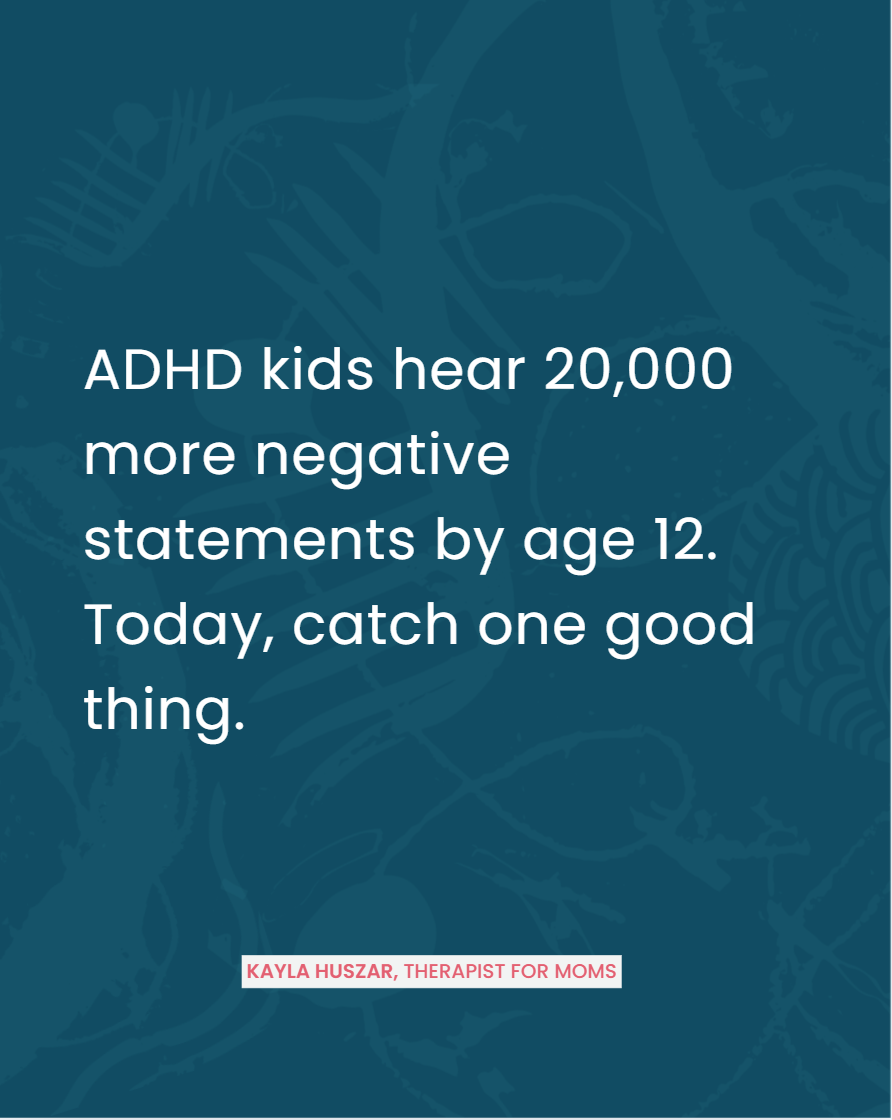
Kayla recently read that ADHD kids hear 20,000 more negative statements than neurotypical children by the time they’re 12 (click here for the article).
Twenty thousand "no's." Twenty thousand "stop its." Twenty thousand "why can't you justs."
So here's what I want you to do today: catch something good. One thing. Notice when your child does something "right" - even if it's tiny, even if it's just that they didn't fight you about turning off the screen this one time - and say it out loud.
"I noticed you came when I called you. Thank you for listening."
"You handled that frustration really well just now."
"I love how creative you are."
It won't fix everything. But it's one statement in the positive column. And those add up too.
5 Evidence-Based Strategies for Neurodiverse Families
1. Gamify Your Routine:
Turn mundane tasks into challenges—if you have the energy. "I bet you can't put on your shoes before this song ends!" Breaking down daily activities into games can make them more enjoyable and manageable—for everyone. Some days this works. Some days it doesn't. Both are okay.
2. Embrace Minimalism (When You Can):
A decluttered space can lead to a decluttered mind. You might have permission to get rid of those seventeen craft kits you bought during a hyperfocus moment and never opened. Less stuff can mean less decisions, which means less overwhelm. But if you can't tackle this right now? That's okay too.
3. Cut Back on Extracurriculars:
Sometimes less is genuinely more. Your child might not need to be "well-rounded" by conventional standards. They might need relaxed, flexible family time where nobody's rushing to the next thing. What if you focused on activities that actually bring joy, not just look good on paper?
4. Build Community Connections:
Surrounding yourself with a supportive community can help combat the loneliness that often comes with neurodiverse parenting. Maybe you can find your people—the ones who don't raise their eyebrows when you explain why your child needs what they need. The ones who get it when you say "we had to leave early."
5. Simplify, Simplify, Simplify:
Simplifying tasks into manageable steps might alleviate some of the overwhelming nature of daily routines. This can be especially helpful if you struggle with executive functioning yourself. You're allowed to lower the bar. You're allowed to do less. What if "good enough" actually is good enough?

Getting ADHD and Autism Parenting Support in Alberta
I'm a Registered Social Worker and Expressive Arts Therapist in Leduc, Alberta (17 minutes from Edmonton's IKEA, if you need a landmark), and I specialize in strategies for neurodiverse families - specifically mothers drowning in the invisible labor of ADHD and autism parenting.
If you're in Leduc, Edmonton, Red Deer, Calgary, or anywhere in Alberta, I offer both in-person and online therapy for parents of neurodivergent kids.
Not more strategies to implement on your own, but actual therapeutic support.
You don't have to do this alone.
Chill Like a Mother Podcast Guest:

Jessica Dunn, is just your average parent with a neurodivergent kiddo, just like you.
She's an advocate for kids on the spectrum as well as those who work hard every day to have their sensory needs met. Her daughter was recently diagnosed with ADHD and Autism and, just like you, is learning to navigate this world a little bit at a time and finding like-minded parents who are trying to do the same. She's here to celebrate the little wins with you, as we all know how big those milestones really are.
P.S. You don't have to do this alone. If you're in Leduc or anywhere in Alberta and you're feeling that bone-deep exhaustion, I see you. Book a counselling session where we can talk about what support actually looks like for you - not another strategy to add to your already overwhelming mental load. Or start with the free Mellow the Meltdown program and give yourself permission to try something different.
What's the most exhausting part of ADHD parenting that nobody warned you about? Share it with me in the comments.
Let's normalize the reality behind the 'special needs supermom' myth.