Session 7: Wait... Maybe I'm Better at This Than I Thought? - Finding Proof You're Not Failing
Welcome back, or welcome if this is your first time with us. However you made it here today - whether you're feeling proud of yourself or still convinced you're failing - you're exactly where you need to be.
Last week, my son came home upset from camp. Instead of rushing to fix things or honestly, embarrassingly, ignoring him because I was busy, I just sat with him. I listened and let him feel heard. I didn’t check my phone - I was fully there.
Later, while beating myself up for what I didn’t finish that day, I realized: I showed up for him exactly how he needed. That mattered.
I’ve been so focused on my mistakes - the yelling, shortcuts, exhaustion - that I forgot the times I’m actually being the mom my kids need.
Then I thought about my mom - not the tough parts I’ve worked through in therapy, but the good. How she made me feel okay about my quirks, sang with me in the car, and spent fun, spontaneous days together scrapbooking, puzzling, or road-tripping.
I'm doing some of that. I'm carrying forward the good parts. And I didn't even realize it.
Does this sound familiar? That moment when you suddenly notice you're not actually failing at everything? When you catch yourself doing something “right” and realize you've been so busy looking for evidence of failure that you've missed all the evidence of success?
Today we're going to intentionally look for that evidence - the proof that you're better at this than you thought. The strengths you've been overlooking. The good you're carrying forward from your own childhood.
What I Hope You Discover Today
Maybe you're carrying forward more good from your childhood than you realized
Perhaps there's evidence all around you that you're doing better than you think
Your body knows when you're showing up as the mom you want to be - you just haven't been paying attention
↓ WATCH THE RECORDING OR SCROLL DOWN TO READ ↓
Gentle Check-In
Before we go deeper, let's just notice what's happening in your body right now.
Think about one moment this week - just one - when you showed up for your kid(s) in a way that felt good. Maybe you were patient when you expected to be frustrated. Maybe you were present when you could have been distracted. Maybe you were kind to yourself when you could have been critical.
Complete these sentence stems:
One thing I did well as a mom this week was...
Something good I learned from my mother/caregiver that I'm carrying forward is...
When I think about looking for evidence that I'm doing okay, my body feels...
And when you think about intentionally looking for your strengths instead of your failures, what comes up? Maybe hope? Maybe resistance because you're so used to the criticism? All of that makes complete sense.
A Different Way to Look at This
Your brain has something called negativity bias - it's wired to notice and remember negative experiences more than positive ones. So every time you mess up, your brain files it away as evidence. But every time you get it right? You might dismiss it as "just doing what any mom would do" or "not good enough."
This is where self-validation becomes important. Instead of waiting for someone else to tell you you're doing okay - seeking reassurance from your partner, looking for proof in how your kids turn out, comparing yourself to other moms - what if you could validate your own experience?
What if you could say "I actually handled that well" or "That was hard AND I showed up anyway"?
Self-validation means recognizing your actual experience - including your strengths and moments of showing up well - as real and worthy of acknowledgment. Not dismissing them, not minimizing them, but actually seeing them.
Here's where the intergenerational piece comes in: When you think about your own mother or caregiver, what if you looked for what was GOOD about how you were raised? Not to erase the hard parts, but to recognize the strengths that were modeled for you - things that might actually be serving you well now.
Today we're going to explore what it feels like in your body when you're showing up well, practice validating your own strengths, and recognize the good you're already doing - because it's there, even if you haven't been noticing it.
Guided Visualization: Finding the Evidence
Safety note: This meditation invites you to reflect on positive memories - both from your childhood and from your current mothering. If thinking about childhood brings up difficult feelings, you can focus just on recent moments with your own kids.
Before we start, write down what you hope to discover about your strengths that you've been overlooking.
Musical Reflection: Take a few minutes to listen to "First Time on Earth" by Alex Warren and write freely about the good parts of how you were raised - what you want to carry forward. Let whatever wants to surface come through.
↓ LISTEN OR READ THIS SCRIPT ↓
If you're willing, get comfortable and take a few breaths with me. Or soften your gaze if closing your eyes doesn't feel right.
Close your eyes and take some deep breaths. Notice your chest rising and falling. Keep breathing until you feel settled in your body.
Think about your mother or whoever raised you - but this time, look for one specific good memory. Maybe a time she made you feel safe, or loved, or seen. Maybe something simple - the way she tucked you in, or made your favorite food, or celebrated something you did. Just one good moment. Notice what you see - the colors, the sounds, the feeling.
What was good about that moment? What did it give you? Maybe it was warmth, or security, or joy, or feeling valued. Just notice what you received from that moment.
Now notice: Are you giving that to your kids in any way? Maybe not exactly the same, but the essence of it. Are you creating moments of safety, or love, or celebration? Just look for the evidence. It's there - you've just been trained not to see it.
Now think about this past week with your own kids. Scan through the days and look for evidence - actual moments when you showed up well. Not perfectly, just WELL. Maybe you were patient during a meltdown. Maybe you listened when you could have dismissed. Maybe you played even though you were tired. Maybe you apologized when you got it wrong. Find at least three pieces of evidence.
For each piece of evidence, notice how it felt in your body when you showed up that way. What does being a good-enough mom feel like physically? Maybe grounded, or warm, or connected, or simply present. Notice the feeling.
Bring all this evidence into view. The good from your childhood that you're carrying forward. The moments this week when you showed up well. The proof that you're actually doing better than you think. Let yourself really see it.
Now move your attention to your heart area. When you can feel your attention there, ask: "What strength of mine have I been overlooking?" Let whatever comes up, come up. Maybe it's your patience, or your humor, or your ability to repair when you mess up, or your fierce protection of your kids' hearts.
Finally, imagine yourself moving through tomorrow actively looking for evidence that you're doing okay - noticing when you show up well, acknowledging your strengths, recognizing the good you're creating. What does THAT feel like in your body?
When you're ready, gently open your eyes.
Creative Practice - Your Choice
Pick whatever feels most accessible to you today - based on what energy you have, what supplies are handy, or just what calls to you.
🎨 Option 1: Draw/Sketch What You Discovered Capture what you found in the meditation. What do your strengths look like? What does showing up well feel like in your body? What's the thread between what you received and what you're giving?
Create a Memories Collage Use whatever materials you have to create a visual representation of the evidence that you're doing better than you think. Include good moments from your childhood, your current strengths, and specific examples from this week.
🖊️ Option 2: Write in Response to the Meditation
List or write freely about: What was good from your childhood that you're carrying forward. At least 5 specific moments from this week when you showed up well. Strengths you've been dismissing.
Remember - this isn't about making something beautiful or getting it right. It's about externalizing what your body showed you about these two versions of yourself and the gap between them.
Take 12-15 minutes with whichever option you chose.
What I Discovered When I Did This Work
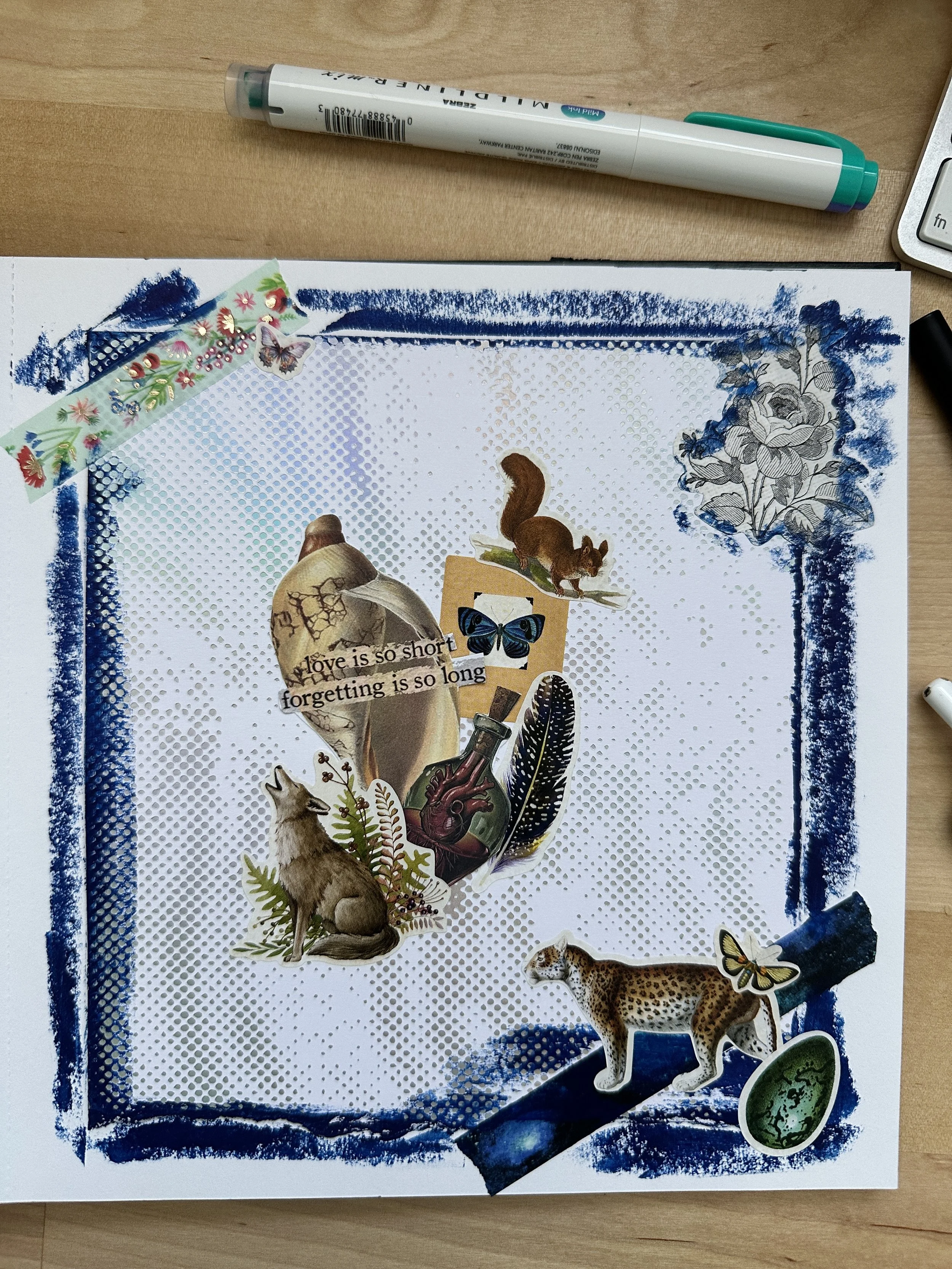
I created a collage that represents my family and how I felt when I unclenched my belly and allowed it to soften into the idea that I'm not failing.
Was it hard for me to find evidence? No. But it was challenging to believe it and hold onto it. I could feel my body letting go - a surrender, an appreciation for good that I've been overlooking.
This is the work. Not just finding the evidence - but letting your body actually receive it instead of dismissing it.
Journal Practice: What Did You Notice?
Take a moment to look at what you created, or think about what came up for you.
What surprised you about the good you found - either from your childhood or from this past week?
Was it hard to look for evidence of doing well? What resistance came up?
When you felt into moments of showing up well, what did that feel like in your body?
What I hear from people is how shocking it is to realize they're actually doing a lot of things well - but they've been so focused on failures that they haven't noticed. The evidence was always there. You just weren't looking for it.
What You Discovered Today
Look what you've done over these seven weeks. You've learned to trust your body's wisdom about overwhelm, criticism, sensory limits, identity, mental load, and guilt. Today you learned to use that body awareness to recognize when you're actually showing up well - because your body knows the difference.
You practiced looking for evidence of your strengths instead of only seeing your failures. You discovered that you're carrying forward good things from your own childhood - not just healing wounds, but continuing legacies of love and presence.
You learned that your brain's negativity bias has been working overtime, making you think you're failing at everything when the evidence shows something different. You're actually doing better than you think.
You practiced feeling in your body what it's like to show up well as a mom - and recognizing that feeling so you can notice it more often.
Here's something to remember: My 10-year-old watches me. He sees how I talk about myself. And if all he ever hears is me listing my failures - "I yelled again," "I'm so behind on everything," "I'm the worst" - what's he learning about how to treat himself?
But when I can say "You know what? I handled that meltdown really well today" or "I was so patient even though I was exhausted," he's learning something different. He's learning that people can mess up AND do things well. That you can acknowledge both without the self-flagellation.
Your kids are watching how you see yourself. Not what you tell them about themselves, but how you actually treat yourself when things are hard. What if acknowledging your strengths isn't selfish - it's modeling that they get to be whole, complex humans who are worthy even when they're not perfect?
What if you're already being a lot of what you hoped you'd be? What if the evidence has been there all along - you just needed to start looking for it?
You're not failing everything. You're actually doing a lot of things well. It's time you started noticing.
Next Week: Session 8: What If I Could Actually Handle This? - Making a Plan That Won't Crash and Burn
Create sustainable practices that work with your real life
Something to Take With You
This week, you're going to become an evidence collector. Not to prove anything to anyone else, but to train your brain to see the whole picture.
Daily practice: At the end of each day, write down at least three pieces of evidence that you showed up well as a mom. They can be tiny - "I didn't yell when I wanted to," "I made eye contact when they talked to me," "I apologized for being snappy."
Now make it tangible:
Where will you keep this evidence? (Notes app, journal, sticky notes on your mirror?) Decide now and set it up.
What time of day will you collect your evidence? (Before bed, during coffee the next morning?) Put it in your calendar.
Who will you share your evidence with? Find one person who will celebrate your wins without dismissing them as "not that big of a deal."
Also this week: Notice one thing you're doing as a mom that directly connects to something good from your childhood. Name it. Honor it. You're carrying forward good things, not just healing hard things.
Gentle questions to carry with you this week:
What would change if you looked for evidence of success as actively as you look for evidence of failure?
How might your kids benefit from seeing you acknowledge your own strengths?
What if you're already being a lot of what you hoped you'd be - you just haven't been noticing it?
This is the work of resilience - recognizing your actual strengths instead of just cataloging your failures.