How to Tolerate Your Child's Big Feelings (Even When They Blame You)
My son looked me dead in the eye and said: "I never get what I want."
This was after a two-week vacation. After a trampoline purchase. After many special things since school had been out. And on this particular night, after I'd said no - gently and firmly - to the TV being turned back on for the third time.

He stomped around. He avoided every bedtime maneuver. He threw stuffed animals, tried to break a Lego, and told me to go away. He shared some disappointment about the vacation. He cried.
I made eye contact when he was protesting and didn't say a word back.
I knew it was already a big feeling night. I knew saying anything would make it worse. So I stayed. And when he finally got to the disappointment underneath all of it, I said: "I believe you."
I could've corrected his facts. I could've listed everything he'd gotten to do. But I knew he was feeling big after two weeks away from home - staying in new places, meeting new people, keeping it together. This inopportune moment was his first real chance to let some of that out.
After his emotional processing, he came out of his room and asked me for a snack and a cuddle. We made a snack - even though it was past bedtime - read a book, and snuggled. As he fell asleep I said "I love you," and he said "I love you too, Mom."
Here's what was happening underneath all of it - and what I've learned about staying in it when it's hard.
A note on not getting it right
It's tough to sit in the disappointment of someone else's feelings. That discomfort is what often leads to losing control or just giving in "because it's easier." It is not, in fact, easier.
I sort of unintentionally quit setting boundaries with my son when his brother was born, and then just continued that pattern throughout the pandemic. That didn't help build his resilience to my saying "no" every once in a while. Now, when I firmly say no and mean it, he reacts big - bigger than if I'd just kept setting limits in the first place.
At any point in this story, you might have done things differently. That's ok.
And it doesn't always turn out this way. I'm not a perfect parent. I don't always hold steady like this. Sometimes I yell and burn it all to the ground and have to repair later.
The parenting experts say we only need to get it right 30% of the time. This was one of those times for me.
How to sit in the discomfort of your child's big feelings (especially when they blame you):
Why does my child save their biggest feelings for me? (And why it's not an attack.)
It's not about you. It's about them and how they feel, and their feelings are valid. The most inopportune moment is often the first available one - your kid held it together all day, and you are safe enough to fall apart with. You don't have to fix it. You don't have to take responsibility for it. It's not yours to own - unless you actually need to take responsibility for something. You are in charge of regulating yourself and the household decisions. They are in charge of their feelings (and how they regulate them).
You cannot regulate them, you regulate yourself and they regulate themselves (this is especially hard for moms who were under-mothered).Count to ten before responding.
It sounds simple. It's easy to forget. Count anyway.
What to say when your child blames you for their feelings: "I believe you."
You don't have to correct or inform them of the facts right now. In this moment, your role as their parent is to believe - not understand - their big feelings. You don't have to understand someone to believe them. It likely won't make any rational sense to you anyway.
Just say "I believe you," stay close even when they tell you to go away, and for the love of all things, stay off your phone when your kid is having big feelings. They need to see that you are available when you actually say you are available.
Do your own work.
This is the one that makes the other three possible.
Feel your own feelings.
Sit in your own uncertainties.
Set boundaries.
Practice self-compassion.
Have personal responsibility.
Don't go back on your word.
Journal.
Do art.
Talk it out with friends and/or therapists.
Do your damn work (aka, get yourself a therapist who supports you in your goals)

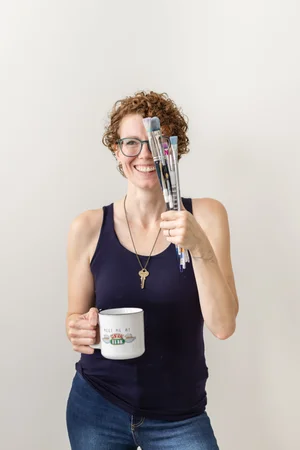
I'm Kayla Huszar
mom guilt THERAPIST
I'm a Registered Social Worker trained in expressive arts therapy, and a mom who gets it.
I work with mothers who are holding it all together (but barely), feeling invisible in their own lives, and wondering if they'll ever feel like they're doing it right - or feel like themselves again.
If something in this post hit close to home and you'd like to learn how to stay emotionally regulated when your child is having big feelings, I'd love to support you.
Work with me
Individual Counselling:
Deep, personalized support using expressive arts therapy. Available in-person in Leduc, Alberta, and virtually in Alberta, Saskatchewan, and Ontario. Direct billing available - covered by many extended health benefit plans through Jane.The Untangle - Consulting Intensive - COMING SOON
Same therapeutic tools, delivered as a consulting intensive. Available worldwide, paid out of pocket in CAD.
Want to build this skill?
Staying regulated when your kid is in the middle of a meltdown is not a personal failing. It's something you practice. And if you're parenting a highly sensitive, spirited, or emotionally big feeling kid, my free video series Mellow the Meltdowns was made for exactly this.
Five sessions. Creativity and mindfulness. No art experience needed. Free.
P.S.
If this post found you at the right moment - follow along for more. New posts, podcast episodes, and resources for moms parenting kids with big feelings drop regularly at kaylahuszar.com and on the Chill Like a Mother podcast.
Original: July 22, 2022
Updated: May 12, 2026