Journaling for Moms Who Are Tired of Being Inside Their Own Heads
BEFORE I WAS A MOM, AS A TEENAGER, I didn't think twice about journaling.
Before bed, after reading A Million Little Pieces for a bit, I would journal about my day. I wrote about my friends, the drama, that bittersweet ache of growing up that I couldn't name but somehow knew was important. I specifically remember filling notebook after notebook. I would pick a word for each entry and put it at the top and then I would write.
Pages of messy handwriting, doodles squished into the margins, the occasional terrible poem about some boy who didn't deserve it. Dark poetry was basically my love language. I dreamed on those pages. I didn't worry about whether I was doing it right. I just knew it felt good to have somewhere to put everything.
Somewhere along the way, as adults and moms, we start calling this kind of thing silly. A waste of time. Childish.
I didn't know it then... but this actually has a name. Expressive writing - which is just a fancier name for what we were already doing in those notebooks - turns out to be one of the most effective and completely free things a mom can do for her mental health.
If you've ever thought about starting a journaling practice - maybe your friend swears by it, maybe you heard something somewhere about the benefits - and then talked yourself out of it because you don't have time, don't know what to write, or figure your thoughts aren't interesting enough... this one is for you.
The directions are simpler than you think. And the research backs it up (in case you need to know that sort of thing).

How to (re)start journaling as a mom
Set a timer. Even five minutes. Twenty is the sweet spot according to the research, but five is good too.
Write whatever is in your head. Don't fix the spelling. Don't reread as you go. Let it come out in whatever order it wants to arrive.
If you need more direction and the blank page feels scary or vulnerable, check out the prompts below.
If time is the real barrier here - you have more room in your day than you might think right now:
Instead of doom-scrolling at 11pm, open the notes app
Let the laundry sit - it will still be there - and write for five minutes first
Trade one Instagram spiral for downloading whatever has been circling your head all day
You do not need a leather-bound journal with a ribbon bookmark. The notes app on your phone works. The back of an envelope works. A random scrap of paper you'll lose by Tuesday - that works too.
What do I write about as a busy mom?
Anything. All of it. The stuff that feels too small to say out loud and too heavy to keep carrying:
"Everyone needed something from me today and I have nothing left."
"I snapped at him again and I hate myself for it."
"That thing that woke me up at 3am that I can't stop turning over."
"My kid did something today that cracked me open in the best way."
If you're staring at a blank page, try one of these:
"Right now I feel..."
"What's bothering me most today is..."
"I don't know where to start, so I'll start here."
Write the same complaint every single day if you need to. Write two sentences and stop when someone interrupts you. Write "I'm too tired to think" when you're too tired to think. You cannot do this wrong.
A few things that don't matter at all: spelling, grammar, making sense, writing in full sentences, having something profound to say. Nobody else is reading this unless you want them to.
A note about the research on journaling
A researcher named Dr. James Pennebaker spent decades studying what happens when people write about their emotional experiences - to get it out. People who wrote regularly about difficult thoughts and feelings showed improvements in mood, fewer trips to the doctor, and greater clarity about their own lives.
He called it expressive writing.
The theory is that when we don't process our emotional experiences - when we just carry them around, suppressing or white-knuckling through them - that effort takes a real physical toll over time. Getting thoughts out, even onto a scrap of paper, releases some of that pressure.
Think of it like a browser with forty-seven tabs open. Writing won't fix what's in them. But it helps you see which tabs actually need your attention - and which ones you can just close.
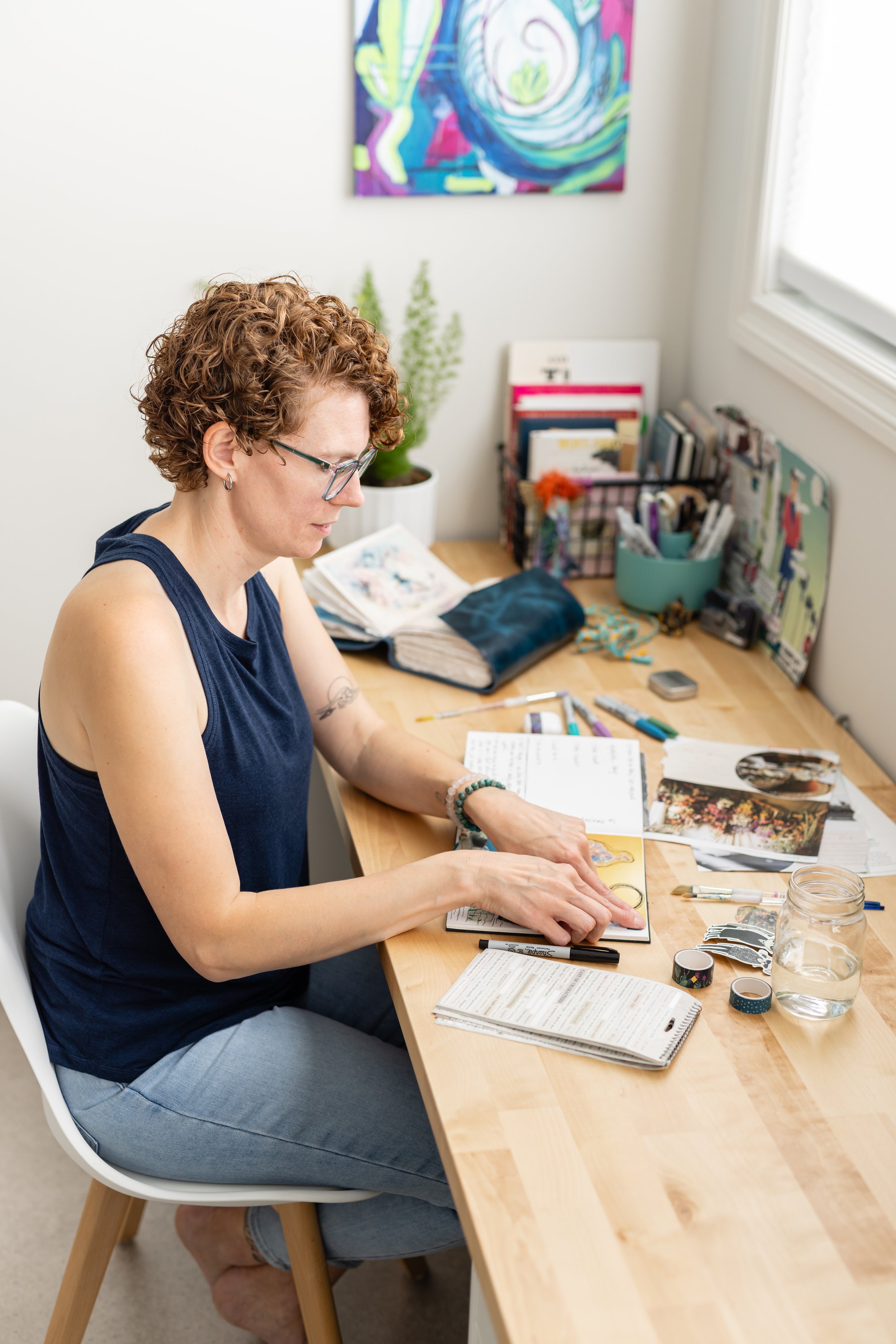
One thing worth knowing: sometimes going toward the hard thing makes you feel worse before it feels better.
A little more emotional, a little more raw. That's not a sign you're doing it wrong - it's actually part of the process. You're moving something that was stuck. Give it a bit of time.
As a Registered Social Worker trained in expressive arts therapy, this is one of the tools I come back to again and again with the moms I work with.
Somewhere between the meal planning and the pediatrician appointments and the endless invisible labour of keeping a family alive, journaling started to or still does feel indulgent.
Like something you'd have to earn first - after the dishes, after bedtime, after everyone else was sorted. There is no after. There's just now, and five minutes, and whatever's been circling your head all day.
Three questions worth journaling about:
How do I feel right now? And why?
Can I do anything about it?
What emotion do I want to feel? What is one small thing I could do to feel that way?
What's one creative thing you used to do as a teenager that deserves a comeback? Drop it in the comments.
P.S. If you want to go deeper into your emotional life as a mom - not just journaling but actually understanding what's underneath all of it - I work with moms in Alberta, Saskatchewan, and Ontario who are ready to stop white-knuckling through it.