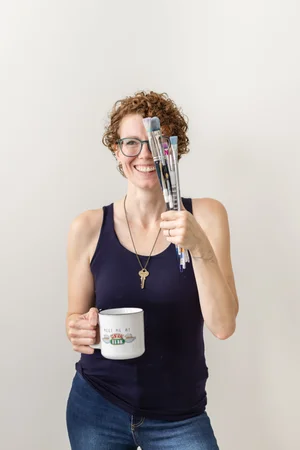
87. Why "I Lost Myself in Motherhood" Is the Wrong Diagnosis with Meghan Watson
My brand new Sharpie acrylic markers were ruined before I ever got to use them.
I'd asked for them specifically for Christmas. The really good ones - the kind with the fine tip and the fat brush end and the colors that come out exactly as saturated as they look on the cap. I had been looking forward to cracking them open.
Then one morning, mid-session in my own expressive arts therapy appointment, I reached for yellow. What came out was a murky, crappy brown.
Every single one of them. My kids had been using them - mixing colors while wet, working through the whole set while I wasn't looking. And there I was, in the middle of what was supposed to be my time, my therapy, my thing, coloring with a brown that used to be yellow. And I was actually p*ssed off.
Then - somewhere around the 60-minute mark - I thought: I am so glad my kids grew up in a house where the art supplies aren't precious. Where creativity is important and messy and real.
Two things were true at once. I was mad about the markers. And I was proud of what those ruined markers meant.
This is the tension so many moms live in around creativity. The wanting-it and the losing-it and the not-quite-knowing-how-to-reclaim-it without someone handing you an hour and a clean table and permission to just make something.
Most moms I talk to name this feeling the same way. "I lost myself in motherhood."
And I get it - the language fits the shape of the experience. But I've started to think it's the wrong-ish diagnosis, calling it loss misses what's actually happening. And what's actually happening is more interesting, and more worth understanding, than loss.
What One Therapist-Mom's Story Gets at That "I Lost Myself" Doesn't
Back in December - yes, I know, I'm a little behind on my editing, it's now the end of April - I sat down with Meghan Watson, a therapist in Ontario, collage artist, and mom to a three-and-a-half-year-old, to talk about exactly this.
Meghan has always been a creative person. Before becoming a mom, her creativity was rooted in words. She ghost-wrote for mental health companies, developed programming, ran a practice, and kept a Substack she'd been writing since 2021. She wrote the way some people breathe - constantly, automatically, from a place deep in her nervous system.
Then she had her son, and somewhere in the fog of those first months, the words that had always come easily stopped coming. That was more disorienting than the sleep deprivation.
Six Months Postpartum, the Creative Well Was Dry
Meghan describes the way she used to write as working from "seeds" - sparks of an idea that weren't yet ready to be seen, but held meaning. She'd be with a client, hear a question, and feel a seed land. She'd be mid-task and something would strike her. Those seeds would eventually become essays, prompts, carousels - the full body of her creative work.
Six months postpartum, she came up for air and realized the seeds weren't coming anymore.
She describes that moment with a kind of startled clarity. Consciousness just woke up and she was there - alive, with a baby, a business, a brain that had been running on fumes for half a year - and utterly creatively spent. She'd been making so much for other people before she gave birth that there was nothing left for herself. And now the well felt completely dry.
What nobody tells you is how destabilizing that is.
Most moms are prepared for the exhaustion - the feeds, the wake windows, the particular chaos of keeping a small human alive.
What they often aren't prepared for is the identity shifts, the guilt, and the way the exhaustion goes so much deeper than tired. What Meghan describes goes to that deeper layer - the slow, awful realization that the creative self you counted on to make sense of your own life has gone quiet. And when that part of you goes quiet, the question underneath is: who am I now?
This is the question that doesn't make it onto the EPDS or new mom checklists.
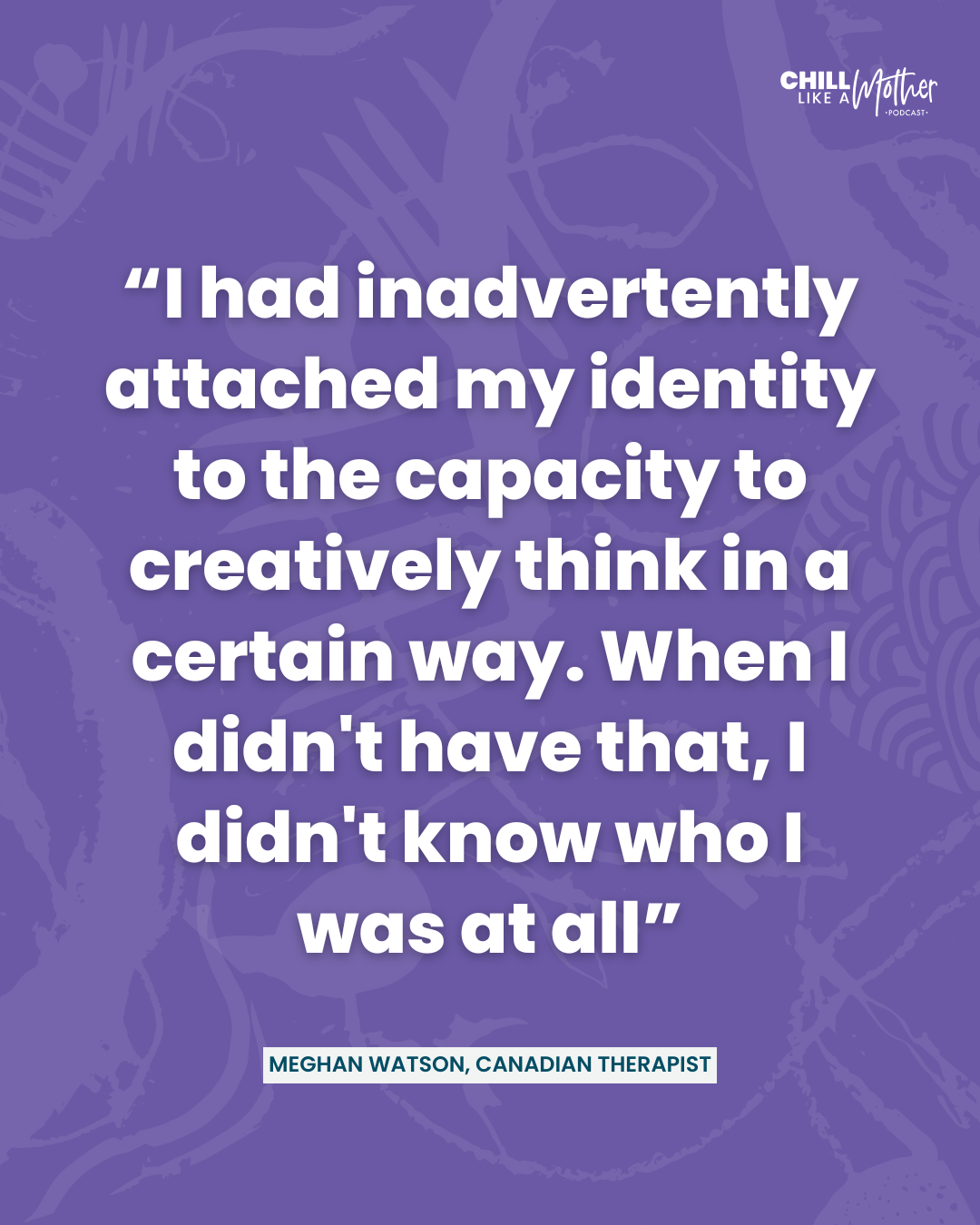
What Was Actually Happening Underneath
What Meghan didn't realize until much later was that the seeds had changed form rather than disappeared.
Without words, she started doing things with her hands.
Cutting shapes.
Coloring.
Reorganizing spaces as her son outgrew each phase - the crib to the big bed, the baby proofing, the shifting and sorting.
She found old bullet journals and magazine collections.
She started reading and absorbing more than she was creating. She felt shame about that - was she consuming more than making? Was she falling behind?
What was actually happening was an alchemy. Her creative intelligence was going somatic, tactile, visual. She was building a visual language she didn't yet have words for. And when she finally let herself go deeper into collage - a practice she'd kept in different forms since childhood - something clicked. The prompts, the words, the journal paths started melting into the visual work in a way that felt completely new.
Looking back, she can see that she was growing into a new season of her creative life - one that looked completely different from anything she'd done before.
There's a word for what Meghan was moving through. Matrescence is the developmental process of becoming a mother - as neurologically and psychologically significant as adolescence, and just as disorienting when you don't know it has a name.
Your brain actually changes.
Your identity reorganizes around something enormous.
The version of you that existed before the baby bag is in the middle of one of the biggest transitions of her life, and nobody handed her a map.
Researchers like Dr. Alexandra Sacks have been working to bring matrescence into mainstream conversation precisely because the gap between what moms experience and what anyone prepares them for is so wide.
What gets diagnosed as postpartum depression or anxiety is sometimes just matrescence - a normal, expected developmental passage that got no cultural acknowledgment and no support. What many moms experience as loss is actually disorientation. The ground shifted and nobody told them it was going to.
So What Is the Right Diagnosis?
"I lost myself in motherhood" carries a particular kind of weight. It implies something went wrong. Something was taken. And the only way forward is to get it back - to return to the person you were before the baby, before the feeding schedule, before the kitchen table got covered in someone else's craft supplies.
That framing is exhausting to live inside. Because you can't go back. And spending your energy trying to recover a previous version of yourself means missing what's actually in front of you.
Matrescence reframes all of it. Becoming a mother is a developmental passage - your brain changes, your nervous system changes, your sense of self reorganizes. The research on this is real and significant. What many moms experience as loss is actually disorientation.
How Meghan keeps a creative practice alive as a mom
One of the most useful things Meghan said in our conversation: the thing that actually keeps a creative practice alive for moms is accessibility - removing the friction between wanting to make something and actually doing it.
Before her son was born, she could set up an hour-long meditative painting session, get out all the watercolors, and fully immerse. That version of creativity required a lot - a setup, a protected block of time, a specific space.
Post-baby, that model collapsed entirely. And rather than mourn it - which she did, for a while - she adapted.
Here's what that looked like practically:
Art supplies in every room of the house, not just one designated area
A piece of paper taped to the wall in her office with washi tape - loose, available, ready
Collage cards with prompts in a flat box she can open in five minutes
A handful of magazines accessible alongside the Crayola paints her son uses
She stopped being precious about medium, substrate, or completion - the goal was to keep her hands in it, in whatever form the day allowed.
Some of us - and I include myself here - have gotten so attached to doing creativity right that we don't do it at all. I know what it's like to have the whole bin of scraps and the acrylic inks and the wet glue and the kitchen table fully covered and the hour and a half the whole setup requires. And I also know what it's like to not have any of that and just... not. I don't have 90 minutes but I always have five.
On Mess and the Recovering Mom Perfectionist
Meghan grew up in a precise household - things done in a certain order, a certain way. She spent a long time describing herself as a recovering perfectionist, but she landed on a reframe that stuck with me: precision over perfection. Precision means reaching your goal and stopping. Perfection means reaching your goal and immediately asking "but should we also maybe...?"
Her collage practice is, by nature, an argument against that second voice. In practice it looks like this:
Scrap bins and flat boxes of clippings rather than finished pieces on display
Old receipts tucked into her bag because the texture felt interesting
Half-finished work that becomes raw material for the next thing
An acrylic painting that keeps changing every time she goes back to it - sharper edge here, gouache there, maybe gesso over the whole thing
No idea where it's going, and going back to it every day anyway
For moms whose creative practice has collapsed under perfectionism, that last one is the whole model. And for many moms - those who weren't raised in homes where mess was welcomed, where imperfect attempts were just part of the air - this is sometimes the deepest work. Realizing that the scrap bin is not a failure to finish things.
Two Places to Start If You've Been Waiting for the Right Conditions
Toward the end of our conversation, I asked Meghan what she'd say to someone who's gotten to the end of this episode and is thinking: but how do I actually start?
She had two specific recommendations that are worth sharing because they're so different from the advice you usually get.
Start a collection.
Not a collection of finished art - a collection of something. A specific type of pen, a notebook design, stickers, takeout menus, anything you can hold and look at. The act of collecting builds what she calls your "curation bone." You practice noticing what you're drawn to. You make small decisions about what stays and what doesn't. Over time, that develops into your own creative taste and direction without requiring you to make anything at all.Draw a small square.
Take a notebook. Draw a small square anywhere on a page. Do one thing inside it - a doodle, a sticker, a mark, a color. Come back tomorrow on a fresh page. Just that, every day. Watch what happens. What do you usually put in the square? Are you wanting to go outside its boundaries? Are you curious about different paper or materials? That curiosity is the signal. That's your creative self saying she'd like to come out.
Both of these work in five minutes on the couch with whatever is nearby.
On Brown Markers and What They Mean
I kept thinking about those Sharpie markers after my conversation with Meghan.
At the end of that therapy session, after all the murky brown and the moment of genuine frustration and the long, slow return to okayness - I was glad. My kids have grown up in a space where creativity is normal and mess is survivable and the supplies aren't always perfect because they get used.
What Meghan's story offers is a reframe worth sitting with. The creative self going quiet after you had kids wasn't a loss - it was a signal that something larger was reorganizing. Your whole sense of self was shifting, and the creative self is almost always the first thing to show the strain of that.
When Meghan finally stopped trying to write her way back and let herself cut magazine pages and collect textures and draw in flat boxes, she wasn't taking a step backward. She was finding the form her creativity needed in that season. The same might be true for you. A small square on a notebook page at 9pm isn't a consolation prize. It might be exactly where you start.
Three questions worth opening your notes app for:
What was your creative life like before you became a mom? What did it look like - what did you make, how did you make it, what did it give you?
When you imagine "being creative" now, what does that picture look like? Is it the old version? Does it still fit?
What's one small thing - a collection, a square, a crayon on the back of an envelope - you could try this week?

Meghan Watson is a therapist and collage artist.
You can follow her on Instagram and find her writing on Substack.
And if this post landed somewhere real for you - share it with the mom in your life who keeps saying "I just don't know who I am anymore."
P.S. The full conversation with Meghan is on Episode 87 of the Chill Like a Mother podcast - Apple Podcasts, Spotify, YouTube, wherever you listen. And if you're sitting with the feeling that it's more than just creativity that's gone quiet - that's exactly what the mom identity work is for. You can find out more at kaylahuszar.com/mom-identity, or come find me on Instagram at @kayla.huszar.