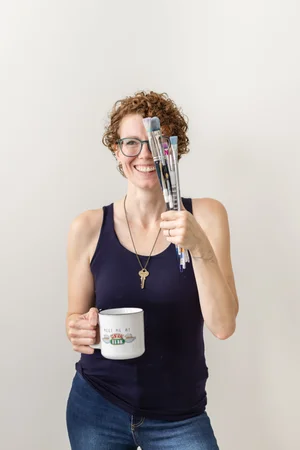
84. A Few Things Millennial Moms Don’t Know About Sitting with Hard Emotions with Jenn Rapkin
When was the last time you had a feeling and just let it be there?
Not ignored your way through it. Not scrolled until it faded. Not filed it away for later. Just let it exist in your body for a minute.
I’m Kayla Huszar - mom guilt therapist based in Leduc, Alberta - and I work with moms on this every day. I recently had Dr. Jenn Rapkin on Chill Like a Mother Podcast, and the conversation hasn’t left me since.
Jenn is a naturopathic physician, bodyworker, and author of The Feeling Muscle: How Felt Emotion Can Help You Sit With and Outlast Hard Feelings. She lives with OCD herself and is raising a child with OCD. When she talks about sitting with hard emotions, she’s not working from a textbook.
words
Why moms struggle to sit with hard emotions
Jenn put the cost of avoidance plainly: if we live our lives daunted by hard feelings, afraid of embarrassment and failure and rejection and shame, we don’t jump at chances. We don’t make the job change. We don’t meet the new person. We don’t go somewhere new.
She named the cultural noise too. Grin and bear it. Pull yourself together. Manage your emotions. Regulate them. Check them. All of it sends the same message: feelings are something to be watched. Controlled. Suspected.
For moms the bind is tighter. Feel enough to be warm and present. But not so much that your feelings take up space. It’s an impossible needle, and most of us are exhausted from trying to thread it.

How to sit with hard emotions as a mom (the feeling muscle method)
Jenn’s framework is this: sitting with emotions is a trainable capacity. She calls it the feeling muscle. Not a personality trait. Not something you either have or don’t. Something you build.
The entry point isn’t the hardest feeling. It’s a beautiful one. A compliment someone gave you. A song that moves you. A sunset. Stop for a minute. Welcome it in. Notice where it lands in your body. That’s the first rep.
From there, you work toward the everyday stuff. The frustration. The anxiety. Jenn describes it as shaking the hand of the feeling - inviting it in, giving it a location, a colour, a shape, a density. Something tangible to sit with instead of something formless and threatening.
That’s not woo. That’s your nervous system doing exactly what it’s designed to do.
How hard emotions move through the body: the 90-second rule
Emotions, when we don’t feed them with story or judgment, typically enter, peak, and leave in roughly 90 seconds. I come back to this research constantly with clients.
What makes them stick is the narrative. I shouldn’t feel this way. Good moms don’t struggle like this. I’m going to lose it and it’s going to come out not so nice. We spin the story and the feeling gets more traction, not less.
Jenn said it like this: when we get hung up on the words and the stories, attaching meaning - that’s when emotion gets really stuck within us. The body has a natural wave-like experience of emotion. It peaks. It dissipates. We’re not practicing staying in the feeling forever. We’re practicing letting the wave move through.
When sitting with hard emotions doesn’t feel safe
Jenn was direct about this: as a bodyworker, she has enormous respect and reverence for the holdings in the body. The numbness. The dissociation. The tension. The places where trauma lives. Her work is not about poking and prodding and pulling feelings out.
Both things are okay, she said. To be with a feeling or not. To be present with it in this moment, or not. Both of those things are perfect.
If your whole body said absolutely not - that’s information, not failure. Start with the beautiful things. Start where it’s safe.
How sitting with hard emotions changes your kids
Jenn’s son was diagnosed with OCD at eight. Just right OCD meant his brain told him to repeat behaviors - crossing a threshold, getting dressed, brushing his teeth - until something inside him felt just right. The goalpost kept moving. OCD swallowed my son, she said. Four years of intensive programs followed.
What eventually helped was SPACE - Supportive Parenting for Anxious Childhood Emotions. The shift it asks of parents: stop fixing. When you’re quick to reassure, Jenn said, you’re sending the message that they can’t handle it on their own. The language that works instead: I see that this is really hard. I see that you’re really scared. And I know you can do this.
When you model sitting with your own hard emotions - naming a feeling out loud, staying okay inside it - your kids learn that feelings are survivable. That’s the ripple.

Reflection:
What’s the feeling you have the hardest time sitting with?
Drop it in the comments. No judgment here.


Need a hand figuring out next steps?
Or just want a little more info?
You’ll find ways to connect below.