6 Steps to Less Mom Guilt: Brene Brown's "The Story I'm Telling Myself" Tool
The moment I realized I was drowning in mom guilt was on an ordinary Tuesday.
My four-year-old was having a meltdown - the kind where his whole body went rigid and he screamed like I'd committed a war crime by getting him to brush his teeth. I'd already tried:
the calm voice
the validation script
the co-regulation breathing I'd seen on Instagram a thousand times
Nothing worked. And somewhere between "I can see you're having big feelings" and him throwing his toothbrush across the bathroom, something in me snapped. Not at him. At myself.

The Stories We Tell Ourselves About Being Good Moms
Because instead of just feeling frustrated - a completely reasonable human response to a screaming kid throwing things - I felt not good enough.
I told myself: "You're failing as a mother. Good moms don't lose their patience. Good moms stay calm. Good moms regulate themselves perfectly so their kids can regulate. You're screwing this up. You're screwing him up. And what kind of mom am I if I can't get him to brush his teeth? Why can't I handle this? I bet other moms don't have this issue. I bet other moms can get this simple task done without a fight."
That story turned a typical parenting situation into a shame spiral so deep that it felt like I was drowning in not feeling good enough.
Here's what I wish someone had told me then: Most of what we call anxiety, rage, or resentment in motherhood is actually guilt and shame in disguise. And those feelings aren't coming from us being bad mothers - they're coming from the impossible social construct of what a "good mother" should be.
The MOM GUILT Tool That MIGHT Change Everything
Brené Brown taught me a tool in Rising Strong that stops these spirals. It's called "the story I'm telling myself" and it works because it creates space between you and the shame.
When we're hurt or triggered (like me standing in that bathroom with a screaming kid and a flying toothbrush), our brains automatically fill in gaps with narratives. Brown calls these "confabulations" - stories we create that often fuel our deepest insecurities.
The problem? We treat these confabulations as absolute truth. We don't say "the story I'm telling myself is that I'm a bad mom." We just think "I'm a bad mom" and spiral.
The practice looks like this:
Instead of: "I suck at this. Good moms don't yell. I'm damaging my kid."
Try: "The story I'm telling myself is that because I raised my voice, I'm a bad mother and I'm traumatizing my child."
See the difference? The first version is a shame spiral. The second version creates space - it acknowledges that this is a story, a narrative you're creating, not an objective truth.
How to Use "The Story I'm Telling Myself" Tool: 6 Steps
STEP 1: Notice the Spiral
Pay attention to when you shift from normal frustration into shame. The physical signs of mom guilt:
Your chest gets tight
Your thoughts spiral ("I'm a bad mom" → "I'm damaging my kids" → "They'll need therapy because of me")
You feel paralyzed or overwhelmed
You start comparing yourself to other moms
In the moment, say to yourself: "I'm spiraling."
STEP 2: Name It as a Story
Say out loud or write down: "The story I'm telling myself is..."
Then complete the sentence with whatever narrative is running through your head, no matter how harsh or irrational it sounds.
Examples:
"The story I'm telling myself is that I'm a terrible mother because I yelled."
"The story I'm telling myself is that my kids will remember me as angry and mean."
"The story I'm telling myself is that if I were a good mom, this wouldn't be so hard."
STEP 3: Get Curious (Don't Judge) - Ask yourself
About the situation:
What actually happened? (Just the facts, no interpretation)
What do I know for sure vs. what am I assuming?
About the other people:
What might be going on for them that I don't know about?
What if their behavior isn't about me at all?
About yourself:
Where did I learn this "rule" about what good moms do?
Whose voice am I hearing in my head - mine, or someone else's?
Is this story based on facts or on fear?
STEP 4: Write the Shitty First Draft
If you can either during or after the acute moment grab your phone or a notebook and do Brené's "Stormy First Draft" exercise:
The story I'm making up:
My emotions: (What am I feeling? All of it, even the ugly parts)
My body: (Where do I feel this physically? Tight chest? Clenched jaw?)
My thinking: (What thoughts are looping in my head?)
My beliefs: (What do I believe about myself in this moment?)
My actions: (What do I want to do right now? Hide? Rage? Shut down?)
You're not trying to fix anything yet. You're just getting it out of your head and onto paper.
STEP 5: Look for Evidence
Now that it's out of your head, you can examine it more objectively.
Ask yourself:
What evidence do I have that this story is true?
What evidence do I have that it's NOT true?
What's another way to interpret what happened?
Example:
Story: "I'm a bad mom because I yelled at my kid over toothbrushing."
Evidence it's true: I raised my voice. I felt frustrated. I wanted him to just comply.
Evidence it's NOT true: I was able to calm myself down, I went back to him and apologized. My kid still loves me and asked for snuggles at bedtime. I was overstimulated and under-resourced, not evil.
Another interpretation: I'm a human being with limits, and I reached mine. That doesn't make me bad - it makes me human.
STEP 6: Give Yourself the Most Generous Assumption
What's the most generous interpretation of what happened? Not the shame version - the human version.
Instead of "I'm a bad mom because I yelled," try "I was completely tapped out and hit my limit."
Give yourself the same benefit of the doubt you'd give literally anyone else.
You Don't Have to Earn Your Worth
I wrote an article for Maclean's about my failed experiment with gentle parenting. It was featured in Apple News Best of 2025 and led to a few CBC interviews. You know what happened after it published? Hundreds of mothers reached out to say, "Me too."
Not because they'd failed at gentle parenting specifically, but because they'd finally seen someone name the thing they'd been carrying in secret: the shame of not being the mother they thought they had to be.
Shame looks like anxiety, anger, and resentment. Under it is a story we learned—from a culture that wants us small, quiet, and constantly giving. You can set that story down.
It's okay to feel overwhelmed. You don't have to force joy every second. You don't owe anyone perfect performance to prove your worth.
The "good mom" story you believe? It never belonged to you.
feeling the mom guilt… more info below
-
As a Registered Social Worker and Expressive Arts Therapist, I work with mothers who are drowning in what they think is anxiety. They come to therapy saying things like:
"Nothing I do is ever enough." "I'm so angry and I don't know where it's coming from." "This is exactly what I wanted, and I still have a deep sadness about my life."
But when we dig deeper? It's almost always guilt and shame about the gap between who they think they should be and who they actually are.
Here's the difference:
Frustration says: "This situation is hard right now." Shame says: "I am fundamentally broken."
Anxiety says: "What if I mess this up?" Shame says: "I AM messed up."
The cultural script we've inherited says good mothers are:
Always calm and regulated
Endlessly patient and gentle
Never resentful or touched-out
Fulfilled by motherhood above all else
Capable of "having it all" and "doing it all" without complaint
When we inevitably fall short of this impossible standard (because it's impossible), we don't just feel frustrated or tired. We feel like failures. And that shame manifests as anxiety about every parenting decision, rage that seems to come from nowhere, and resentment toward the people we love most.
You're not anxious because you're failing. You're experiencing shame because you're trying to meet an impossible expectation.
-
When we're hurt or triggered, our brains don't like gaps in understanding. So they fill them in automatically with narratives—stories that often fuel our deepest insecurities.
Brené Brown calls these "confabulations" in her book Rising Strong.
Here's how it works:
What actually happened: My kid screamed about teeth brushing and threw his toothbrush.
The gap my brain filled in: "This means I'm failing as a mother. Good moms don't have these battles. I'm screwing him up."
The problem? We treat these confabulations as absolute truth. We don't pause and think "hmm, this might just be a story I'm creating." We just believe it and spiral.
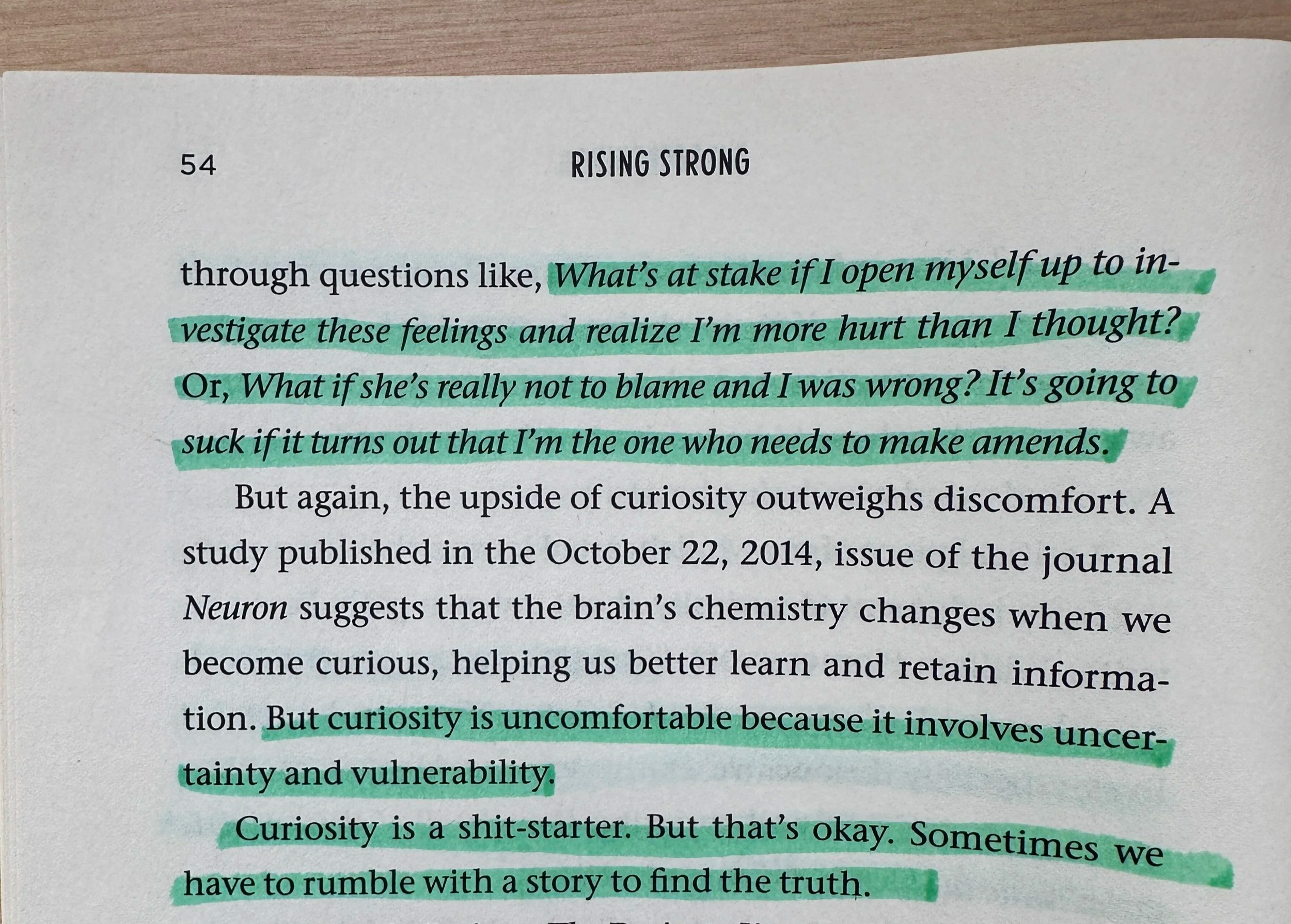
Getting curious about these stories requires vulnerability. As Brené Brown writes in Rising Strong: "Choosing to be curious is choosing to be vulnerable because it requires us to surrender to uncertainty."
And that's not easy work. Getting curious about our mom guilt stories means:
Being brave – because getting curious about emotion is not always an easy choice
Thinking through hard questions like: What's at stake if I open myself up to investigate these feelings and realize I'm more hurt than I thought? Or what if he's really not to blame and I was wrong?
Developing awareness – we have to have some level of awareness before we can get curious
As Brené writes: "We don't know enough and/or we aren't sufficiently aware of the power of our emotions and how they are connected to our thoughts and behaviours, so we fail to get curious."
That's why naming it as a story—"the story I'm telling myself is..."—is so powerful. It creates just enough space to examine what's actually happening versus what your brain filled in.
-
Here's what most parenting advice won't tell you: Motherhood as we know it—the intensive, self-sacrificing, always-calm, perfectly-balanced version—is a social construct, not a biological imperative.
The "good mom" ideal we're all chasing? It's a relatively recent invention, shaped by:
White, middle-class values
Capitalist productivity culture
Social media performance
Outdated gender roles
Patriarchal expectations
And it's making us sick.
In that bathroom with my screaming kid, the story I was telling myself was: "Good mothers are gentle and have patience and are not irritated by a tiny person who won't brush their teeth… if he doesn't brush his teeth, we will have another big dentist bill and I'll have to explain to the dentist why he has cavities. Good moms can get their kids to brush their teeth."
But when I examined that story? I realized it wasn't even mine. It was Instagram's story. It was the dominant cultural narrative that "gentle" equals "good" and anything else equals damage.
It was the social construct of motherhood telling me that my worth as a mother was tied to my ability to perform perfect emotional regulation while my kid threw toothbrushes.
None of that was true. It was just the story I'd absorbed from a culture that expects mothers to be superhuman.
-
Dr. Sophie Brock's research on motherhood confirms what I see in my therapy practice every day: the pressure to conform to narrow definitions of "good motherhood" creates psychological distress that shows up as anxiety, depression, and rage.
Her research on maternal mental health shows that the pressure to meet these impossible standards creates genuine psychological harm.
The anxiety you feel? It's not personal weakness. It's a reasonable response to being set up to fail.
The rage that seems to come from nowhere? It's not you being "unhinged." It's your body's response to chronic stress and impossible expectations.
The guilt that follows you everywhere? It's not evidence that you're doing something wrong. It's evidence that you've internalized a set of rules that were designed to be unattainable.
When I work with clients, I help them identify where their anxiety and rage are actually rooted in guilt and shame about these constructed ideals.
It sounds like:
"The story I'm telling myself is that if I put my kids in daycare, I'm choosing my career over them."
"The story I'm telling myself is that real moms don't need breaks this often."
"The story I'm telling myself is that if I can't handle this with grace, something is wrong with me."
It feels like:
Anxiety before every parenting decision (because you're terrified of getting it "wrong")
Rage that seems disproportionate to the situation (because you're exhausted from trying to be perfect)
Resentment toward your partner, kids, or life (because you're doing it all and still feeling inadequate)
All of these are shame responses. You're not actually anxious about whether screen time will ruin your kid. You're ashamed that you "need" to use it. You're not actually enraged that your partner didn't load the dishwasher right. You're enraged that you're carrying the mental load alone and still being judged for how you do it.
-
Here's what I've learned working as an Expressive Arts Therapist: when we're drowning in shame stories, we lose access to ourselves. To our creativity. To our authentic voice. To the parts of us that existed before "mom" became our entire identity.
Writing the "Stormy First Draft" isn't just a therapeutic exercise—it's expressive writing. It's creativity as emotional regulation.
Here's how to take it further:
After you write your Stormy First Draft, grab a second piece of paper and:
Draw or scribble the FEELING of the shame story (not the words—the energy)
Use colors that represent the emotion (reds for rage, grays for heavy, black for dark)
Fill the whole page with the feeling
Then on the BACK of that same paper, draw/scribble the TRUTH version (what's actually happening minus the shame)
Notice how getting it out of your body and onto paper shifts the energy
Optional: Rip up the first side (the shame side) or fold it away. Keep the truth side visible.
This is what I mean when I say creativity isn't a luxury for mothers—it's medicine. Getting curious about the stories we tell ourselves? That's how we start to reclaim the creative, complex parts of ourselves that got buried under "mom."
That's how we move from shame to truth. That's how we reconnect with who we actually are underneath the impossible standards.
And if you can't write it down, you can ask yourself these questions out loud or talk them through with someone you trust.
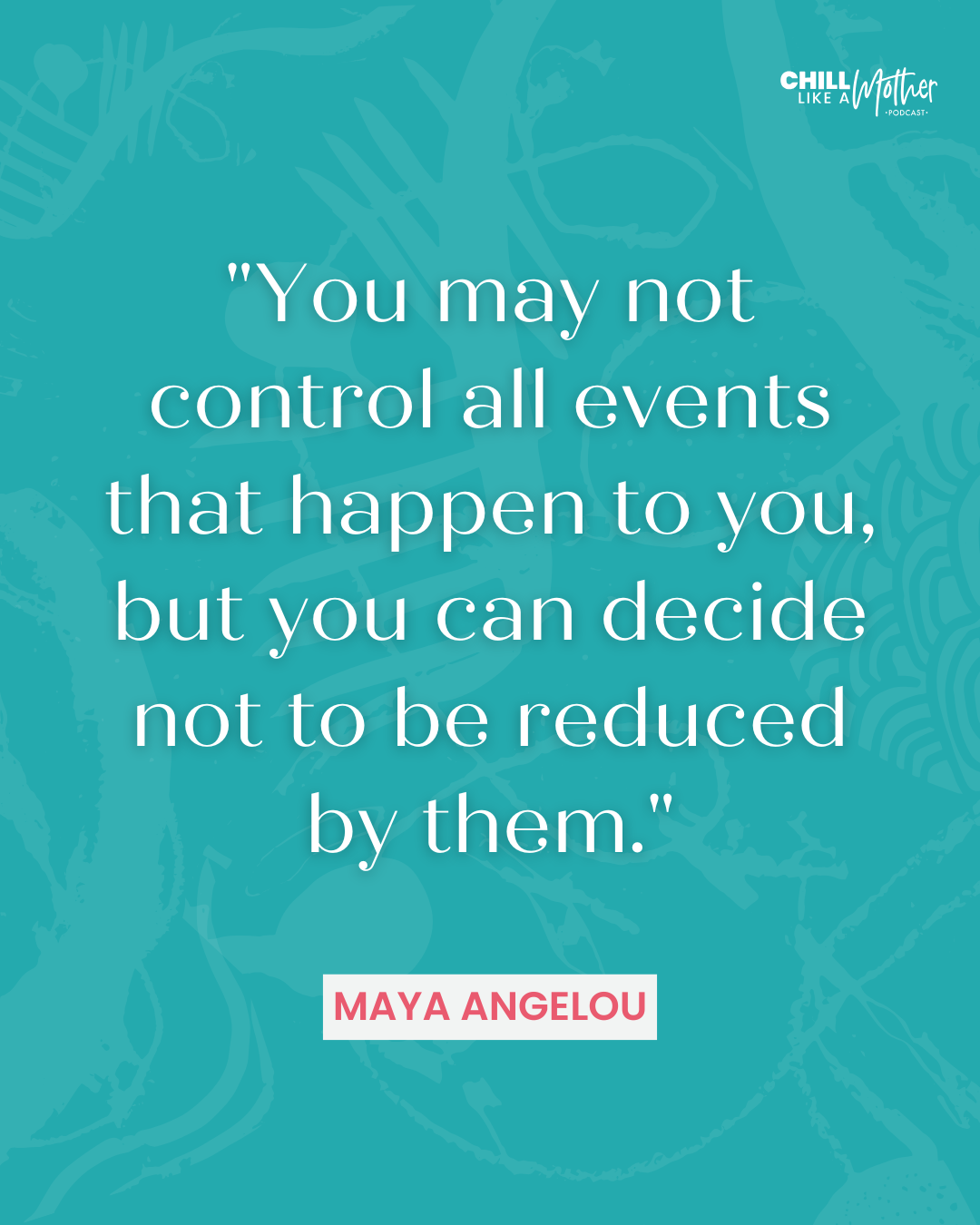
This is what Maya Angelou meant when she wrote about not being reduced by what happens to us. We can't always control the meltdowns, the impossible standards, or the cultural narratives we've inherited. But we can choose not to let them define us.
Brené offers some practical strategies for reckoning with these emotions:
Permission slips (literally giving yourself written permission to feel)
Paying attention (noticing what's happening in your body)
Box breathing (4 counts in, 4 counts hold, 4 counts out)
Mindfulness practices
And this: "Owning our stories means reckoning with our feelings and rumbling with our dark emotions."
That last one? That's the work. Not bypassing the shame or trying to positive-think your way out of it, but actually facing it.
-
Step 6 is about self-compassion, not toxic positivity.
You're not trying to replace a "bad" story with a "good" story. You're trying to extend to yourself the same grace you'd give literally anyone else.
Back to that Tuesday in my bathroom. After I snapped—after I yelled and sent my kid to his room and sat on the floor feeling like the world's worst mother—I finally used the tool.
"The story I'm telling myself is that I've failed at being calm, which means I've failed as a mother."
And then I asked: Is that true?
No. What was true for that moment is that I was overstimulated, under-resourced, and trying to perform an impossible standard of motherhood that no human could sustain. What was true was that my kid was having a hard time, and so was I, and neither of us was broken.
The shame lifted. Not completely, not permanently, but enough to breathe.
The most generous assumption looks like this:
When you examine the evidence and realize the shame story doesn't hold up, you give yourself the interpretation you'd give a friend:
"I was at my limit." "I'm doing something incredibly hard with inadequate support." "I'm human and I have limits."
This isn't about letting yourself off the hook or excusing behavior you want to change. It's about stopping the shame spiral so you can actually learn, repair, and move forward.
The truth: You're not a bad mom having a bad moment. You're a good mom having a hard moment. There's a difference.
Need a hand figuring out next steps?
Or just want a little more info?