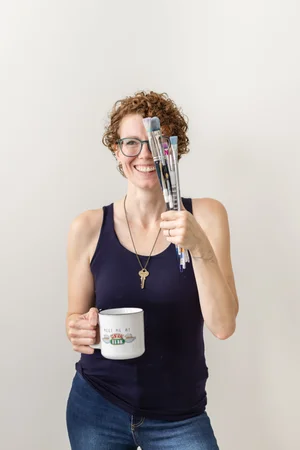
88. "If I Don't Do It, No One Will" - What That Gnarly Mom-Brain Thought Is Really Telling You with Angela Tam
"If I don't do it, no one will" is one of the most common things I hear from moms - and it almost never means what it sounds like.
On a recent episode of Chill Like a Mother, I sat down with Angela Tam - licensed mental health therapist, couples coach, and founder of Cedar & Rain Consulting. Angela is ADHD, a parent of three, and a self-described recovering over-functioner. She works with people who are incredibly capable but exhausted, helping them build relationships that don't require self-abandonment.
She started our conversation mid-Bridgerton spiral. She was watching Season 4, fixating on Lady Bridgerton - a widowed mom of eight who, after 14 years alone, finds herself hesitating toward a man who is basically a walking invitation to enjoy her life.
She can't do it. She keeps pulling back, because leaning toward him feels like a guilty, delicious pleasure. And more than that, it feels like betraying her role. Angela paused and said: I relate to her. So do a lot of moms.
Why Moms Feel Like They Have to Do Everything
Angela described her daughter's ninth birthday party. The gift that made all the girls squeal wasn't a science kit or a Lego set. It was a Mini Brands waffle maker - a tiny, adorable kitchen appliance. Angela stared at it thinking: oh. Right. This is what we were raised to care about. From the toys we're handed to the roles we step into as moms, there is a long, sustained message that says this is your job.
The house.
The kids.
The logistics.
The mental load. All of it.
That message is so old and so constant it stops feeling like a message. It just feels like who you are.
Angela calls it the mask. The mask of doing everything gets fused so tightly to a mom's identity that questioning it feels like losing something essential.
Ask most moms if they over-function and many will say: yeah, and? That's just what's expected of me.
Which is true. And what it costs is your sleep, your relationships, your sense of self, your creative life, your body, and eventually your patience for the people you love most.
The doing-everything isn’t priceless like the old Mastercard commercials - it just hides the total cost.
"If I Don't Do It, No One Will" - It's Probably Not About the Dishes

As a mom guilt therapist and registered social worker trained in expressive arts therapy, I hear about the dishes a lot.
Every mom has her version of the thing:
The laundry that has been in the dryer for three days
The school permission form that somehow only you knew about
Swimming lesson registration opening the same week as your mother-in-law's birthday - and you are the only person on earth tracking both
The pediatrician appointment that needs to be booked four months out and lives only in your head
The snack situation before the seven-hour road trip that no one else has thought about
The dishes are just a useful stand-in.
When a client tells me she can't sit down and read her book until the dishes are done, I walk through it with her.
Okay - if you don't do the dishes tonight, what happens? They'll be there in the morning.
And then? I'll be stressed and there's no counter space to make lunches.
And then? I'll probably just do them quickly anyway. So they get done.
The anxiety is real. But the dishes are rarely the core of it.
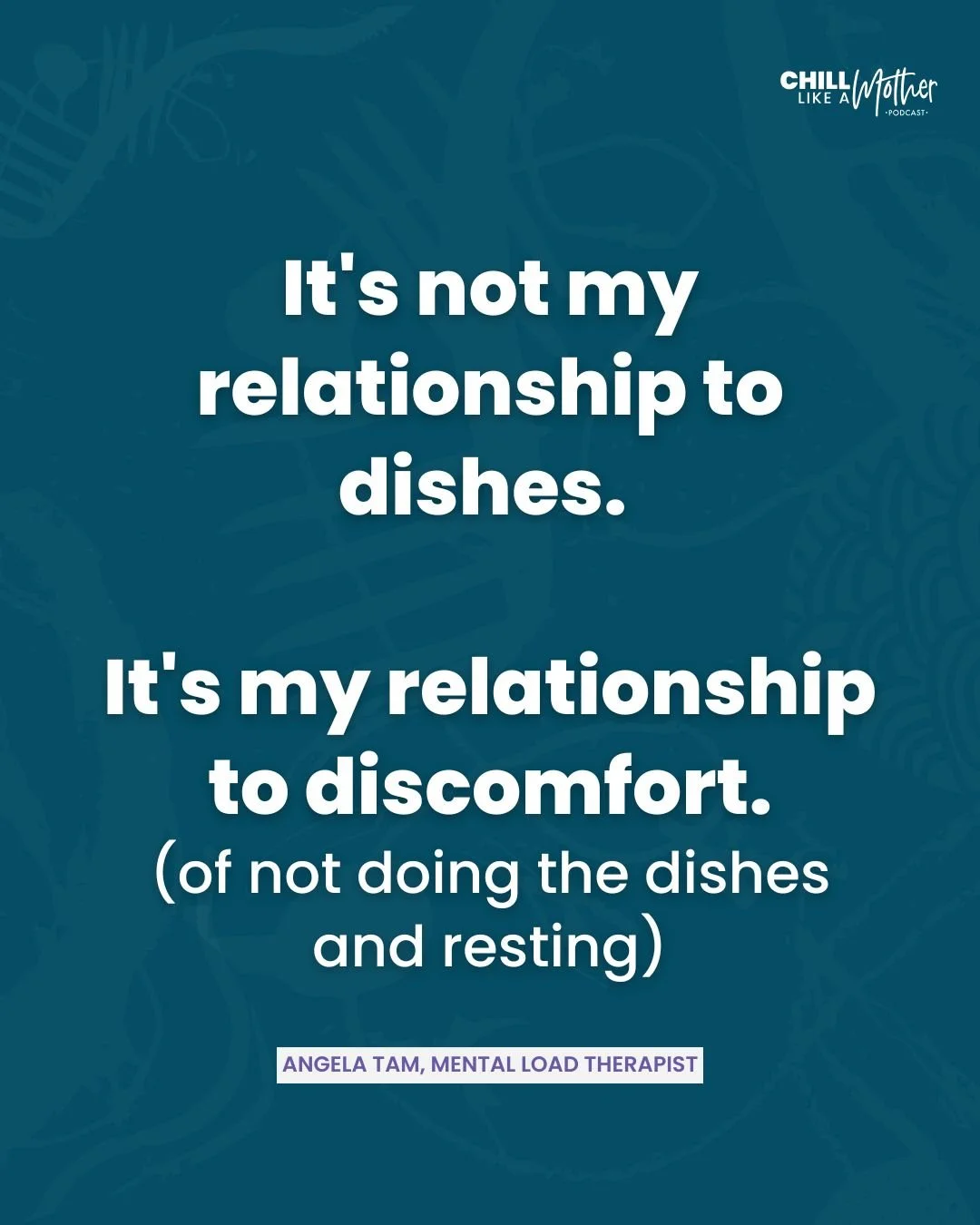
Angela put it plainly: her relationship to the dishes was actually her relationship to discomfort. She knows this because she deliberately renovated her kitchen to have a sink big enough that dishes could sit in it without triggering a spiral. That was the only reason. She needed physical space to practice tolerating the discomfort of leaving them there.
Five Steps for Moms Who Are Done Being the Default Parent
Angela shared the roadmap that worked for her. She was honest that the steps read simply and doing them is not. The first one especially took her years.
Step 1: Stop seeing your partner as the problem.
Angela pissed herself off when she first heard this. She had the Fair Play spreadsheet. Her husband was doing 10 things on a 100-point list. She was doing 90. "If you do 10% of the things and I do 90, you owe 90% of the problems. That was my mentality."
The shift Angela is pointing to: he contributes to the problem - of course.
But the mental load imbalance is a symptom. "What is the actual problem?" she kept asking. The actual problem is a disconnect. And a disconnect has two people in it.
Visit Olivia Scobie
Step 2: Get curious about your 50%.
If he's not contributing 90% of the problems, what is your 50% that you're contributing? That's Angela's question - not the chore list, the dynamic. What did you bring into this relationship? What patterns are yours?
Step 3: Radical honesty.
Angela grew up in a critical, judgmental home. Her flavor of the 50% was her inner critic - the taskmaster that managed everything before anyone could find fault. Your version will be specific to you. The radical honesty is looking at the root of it.
Step 4: Radical leadership.
Angela described this as owning your 50% and naming the impact out loud. "I can see what I've contributed. I want to walk with you in a new way of relating."
Step 5: Heal from it - for its own sake.
Angela was clear: "I'm going to repair for the sake of repair." No agenda. No "if I repair, then he'll change." Just: this is what I've contributed, and I want to repair it.
She said the hardest part is Step 1 - "man, that took me years. I was a whole ass therapist saying there is no way I'm part of the problem."
Why Moms Who Do Everything Might Be Blocking Their Partners
I arrived at couples counselling after my first son was born on what I can only describe as a righteous high horse. I had a degree in human communication. I had read all the books. I was finally going to have someone on my side.
I left furious. Because the therapist called out my part in it too. By doing 90%, I had made it so my partner could only do 10%. I was the roadblock. I had to back off so he could step up.
Even now, hearing it out loud, my old self would have rolled her eyes so far back they'd be permanently stuck. It still feels medicinal, and deeply uncomfortable at the same time.
When I started doing less, my partner had room to do more. That meant tolerating things not being done my way, on my timeline, or at all for a while.
Divesting from over-functioning, Angela said, is about the lens. The one that scans every surface, treats every undone task as a personal failure, and turned a nine-year-old's birthday waffle maker into a symbol of everything you were ever told to be.
She looked at her bank account. She had spent so much on her kids, on food, on the household. Almost nothing on herself. When she started investing in her own healing, her own development, her own pleasure - that's when things started to change.
Look at your financial statements, she said. They show you what you actually value. Are you in there?
What to Do When You're the Mom Who Does Everything
If you were to follow the anxiety about the dishes - or the laundry, or the school forms, or your version of the thing - all the way down: what would you find at the bottom?
Most moms who do this find something old. Something that was there long before the kids arrived. That's usually where the conversation needs to go next.
I'm Kayla Huszar, a mom guilt therapist and registered social worker trained in expressive arts therapy. I work with mothers in Alberta, Saskatchewan, and Ontario.
When you catch yourself thinking 'if I don't do it, no one will' - what does that actually feel like underneath? Is it really about the dishes, or is it something older? Drop it in the comments.
Listen to the full conversation with Angela Tam on Chill Like a Mother Podcast, Episode 88.
Angela is a licensed therapist and couples coach who has been in the mental load trenches herself - and she has a way of saying the uncomfortable truth that makes you feel understood, not called out. Find it on Apple, Spotify, YouTube, or wherever you listen. Search Chill Like a Mother.
Angela's practice: cedarandrain.org | YouTube: Invisible Load Reset